
For a startup, growth is exciting until the technology behind that growth starts becoming difficult to manage.
A few servers have multiple environments. Manual deployments turn into release bottlenecks. Development teams spend more time fixing infrastructure issues, and a sudden increase in users can expose reliability problems that were never visible during the early stages.
This is where DevOps consulting can make a difference.
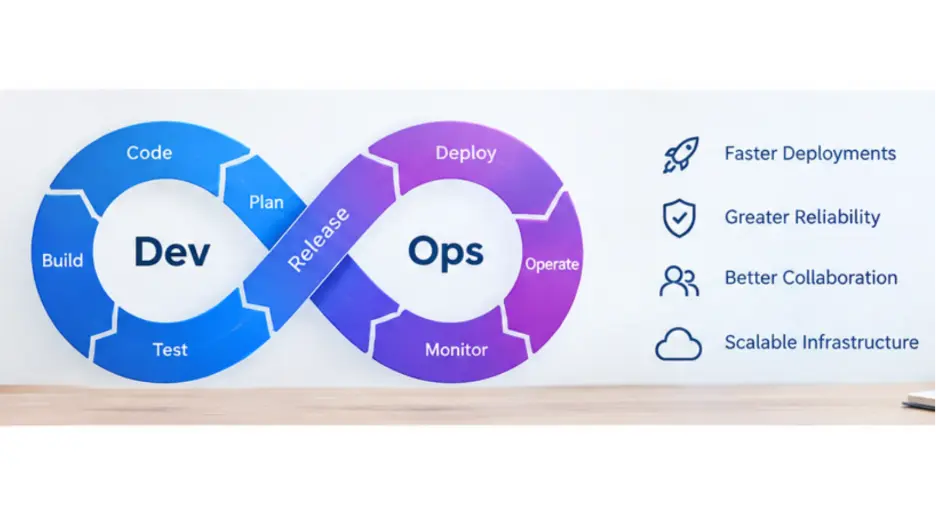
A DevOps consultant helps startups build a more reliable connection between development, infrastructure, testing, deployment, and operations before those systems become difficult or expensive to change. The goal is not simply to add more tools. It is to create a technical foundation that can support growth without slowing the business down.
Scaling Software Is More Than Adding More Servers
When a startup gains users, transactions, and data, its infrastructure needs to evolve with them.
An application that performs well with a few hundred users may behave very differently when traffic increases significantly. Database bottlenecks, deployment failures, configuration inconsistencies, slow releases, and infrastructure limitations can begin affecting the product and the customer experience.
A DevOps strategy addresses these challenges by connecting software development with infrastructure and operational processes.
Instead of reacting to technical problems as they appear, startups can plan for scalability, reliability, security, and efficient software delivery from the beginning.
When Should a Startup Consider DevOps Consulting?
Startups do not necessarily need a large DevOps team on day one. However, certain signs indicate that professional guidance can become valuable.
Consider DevOps consulting services when:
- Deployments are still heavily manual.
- Developers are responsible for infrastructure tasks they were not hired to manage.
- Releases are becoming slower or riskier.
- Development, QA, and operations work in disconnected environments.
- The application is moving from a single environment to multiple environments.
- Infrastructure costs are becoming difficult to predict.
- Production issues are discovered only after users report them.
- The startup expects rapid growth or a significant increase in traffic.
Addressing these problems early can be easier than rebuilding the delivery and infrastructure model after the product has already scaled.
Build a CI/CD Pipeline Before Releases Become a Bottleneck
As development teams grow, releasing software manually becomes increasingly difficult.
A CI/CD pipeline automates important steps such as code integration, testing, build creation, and deployment. This allows teams to release smaller changes more frequently while reducing repetitive manual work.
A well-designed pipeline can also create consistency between development, testing, staging, and production environments.
For startups, this means developers can spend less time managing release processes and more time improving the product.
The objective is not to automate everything immediately. A DevOps consultant can help identify which parts of the software deployment process should be automated first and how the pipeline should evolve as the product grows.
Integrating automated software testing into the delivery workflow can also help teams detect defects earlier and validate changes before they reach production.
Create Infrastructure That Can Grow With the Product
Infrastructure decisions made during the early stages of a startup can have long-term consequences.
A DevOps consultant can help evaluate cloud infrastructure, deployment environments, resource requirements, and architectural patterns based on current needs and expected growth.
This may include cloud migration, containerization, infrastructure as code, automated provisioning, load balancing, and scalable application architecture.
Using tools such as Docker and Kubernetes can also make applications more portable and easier to manage across environments when containerization is appropriate.
The important point is to avoid building infrastructure around today’s traffic when the product is designed for tomorrow’s growth.
For startups planning to modernize their infrastructure, cloud migration and infrastructure automation can support more consistent deployments, resource management, and long-term scalability.
Reduce Deployment and Infrastructure Risk
Scaling quickly can introduce operational risks that are easy to overlook.
A configuration that works in one environment may fail in another. A deployment can introduce unexpected downtime. A missing rollback process can make a production incident harder to resolve.
DevOps automation helps reduce these risks by standardizing repetitive processes and creating predictable workflows.
Infrastructure as code can make environments easier to reproduce. Automated testing can validate changes before deployment. Version-controlled configurations can improve visibility into infrastructure changes. Monitoring and logging can help teams understand what is happening after a release.
Together, these practices create a more controlled production environment.
Make Monitoring Part of the Scaling Strategy
Deployment is only one part of DevOps.
Once an application is running in production, teams need visibility into performance, availability, errors, infrastructure resources, and user-facing issues.
DevOps monitoring and observability help teams detect problems earlier and understand their underlying causes.
Instead of waiting for customers to report that an application is slow or unavailable, teams can use metrics, logs, alerts, and monitoring dashboards to identify abnormal behavior.
This becomes increasingly important as a startup moves from a small application to a more complex scalable software ecosystem.
Avoid Building Technical Debt Into Your Growth
Startups naturally prioritize speed. The problem occurs when temporary technical shortcuts become permanent infrastructure.
A quick manual deployment may be reasonable for an early prototype. A manual deployment process supporting dozens of releases every month is a different situation.
Similarly, an infrastructure setup that works for a small user base may become expensive or unreliable at scale.
A DevOps consultant can help identify where technical debt is beginning to affect delivery speed, reliability, security, or infrastructure costs and establish a practical roadmap for improvement.
DevOps Should Grow With the Startup
The purpose of DevOps is not to make a startup’s technology stack unnecessarily complicated.
It is about creating a delivery and infrastructure model that can evolve as the product, team, and customer base grow.
A practical approach may begin with version control and automated builds, then expand into continuous integration, automated testing, deployment automation, infrastructure as code, monitoring, containerization, security practices, and cloud optimization.
For startups building new products, combining these practices with custom software development can also help ensure scalability and operational requirements are considered during development rather than after launch.
Build the Foundation Before Growth Exposes the Gaps
Scaling software without a reliable delivery and infrastructure strategy can create problems that become increasingly difficult to solve later.
A DevOps consultant can help startups establish CI/CD automation, scalable infrastructure, monitoring, deployment processes, and operational practices that support sustainable growth.
Mechlin’s DevOps consulting services cover areas such as CI/CD, containerization, infrastructure automation, cloud infrastructure, and collaboration across development, QA, and operations.
The earlier a startup treats infrastructure and delivery as part of its product strategy, the easier it becomes to scale without letting operational complexity slow the business down.
Build fast. Automate wisely. Scale with confidence.